
From the highway, Porterville looks much like other towns scattered across California’s Central Valley. The small city of around 60,000 residents sits at the southern base of the state’s Sierra Nevada mountain range, its citrus groves and vineyards giving way to the rolling foothills of Sequoia National Forest.
The local school system, Porterville Unified School District, stewards an especially diverse student population. Roughly a quarter of the K-through-12 district’s approximately 14,000 students are English language learners and about half of families live below the poverty line. Agriculture drives the local economy, and many students grow up watching parents and relatives work the fields that surround the city from all sides. Many are the first in their families to explore careers beyond them. These realities have long influenced the district’s approach to education. In fact, career pathways, internships, and hands-on learning are woven into programs and curriculum.
Among the latest to gain traction is a unique storytelling and digital media initiative called Camp Create. Spearheaded by communications professionals Hannah Moore and Diego Corona, it’s a unique opportunity that puts students at the heart of telling their schools’ stories. Over the past two years, the two have worked together to build what was once an idea into a rapidly growing program that’s gained recognition from not only local families, but media outlets, the National School PR Association, and other districts looking to pilot similar programs. At the heart of it, the pair have tapped social media as an avenue for hands-on learning–one that gives students the chance to build creative skills, explore career interests, and highlight stories from across this diverse school community.
A Human Approach to Storytelling
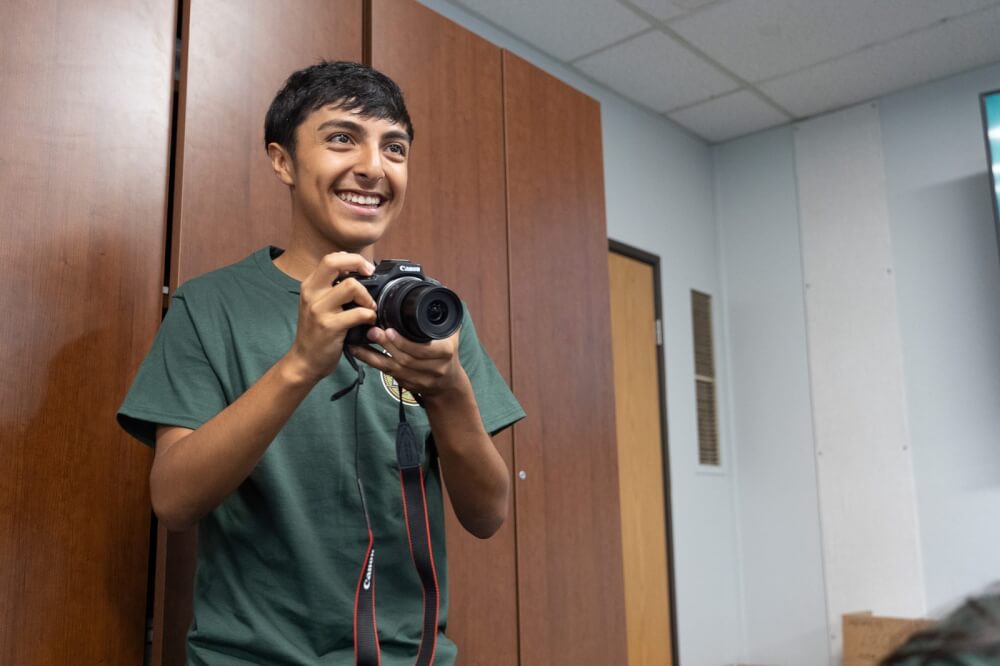
“Schools have so many stories that nobody ever hears about,” says Diego. He’s a tenured Digital Media & Content Coordinator with a passion for video, photography, and bringing good stories to life.
He and Hannah view school communication as something with far more depth and strategy than simply updates and announcements. Their approach is to bring the day-to-day happenings of Porterville schools in full view for the broader community.
“If we were able to showcase every single one of those stories,” continues Diego, “People would just be like, ‘Oh my gosh, I didn’t know all that happened.’”
The Challenge of School Storytelling
Hannah joined Porterville’s communications team from the private sector, where she gained experience in digital advertising and brand strategy–experience that reinforced a core belief that creative skills can open doors.
“You can work in marketing in any industry,” explains Hannah, noting that both creative and analytical skills are incredibly transferable. “Everybody needs marketing.”
Her perspective fit naturally alongside Diego’s. After nearly a decade in school communications, he’d become increasingly interested not just in storytelling, but in capturing the stories that often go unnoticed across such a vast and diverse community–the cafeteria workers preparing breakfast before sunrise, the custodians who quietly care for school campuses, the librarians, office staff, and students whose work rarely makes headlines.
While the possibilities were endless, the practical reality presented constraints. Diego and Hannah are just two individual people. Between thousands of students and hundreds of teachers spread across 22 buildings in total, it just wasn’t feasible for them to capture stories from across the school community. As a two-person communications team supporting a large district, Hannah and Diego knew they would never be able to cover every classroom, campus, performance, or athletic event themselves.
To capture and tell more stories, they would need more storytellers.
“Kids are already creating content,” Diego explains. He’s a behind-the-scenes type–often persisting into the details or anomalies of what appears on the surface to be obvious… the places where there are richer, deeper stories to tell. He has a quiet boldness, the kind that students recognize quickly. “They’re this generation that has grown up online and is consuming so much information in these digital formats. They already know how to create and edit videos almost intuitively,” he adds. “We wanted to take that focus and be like: You can do this for your school.”
And so, Camp Create was born.
Creating Opportunities to Create
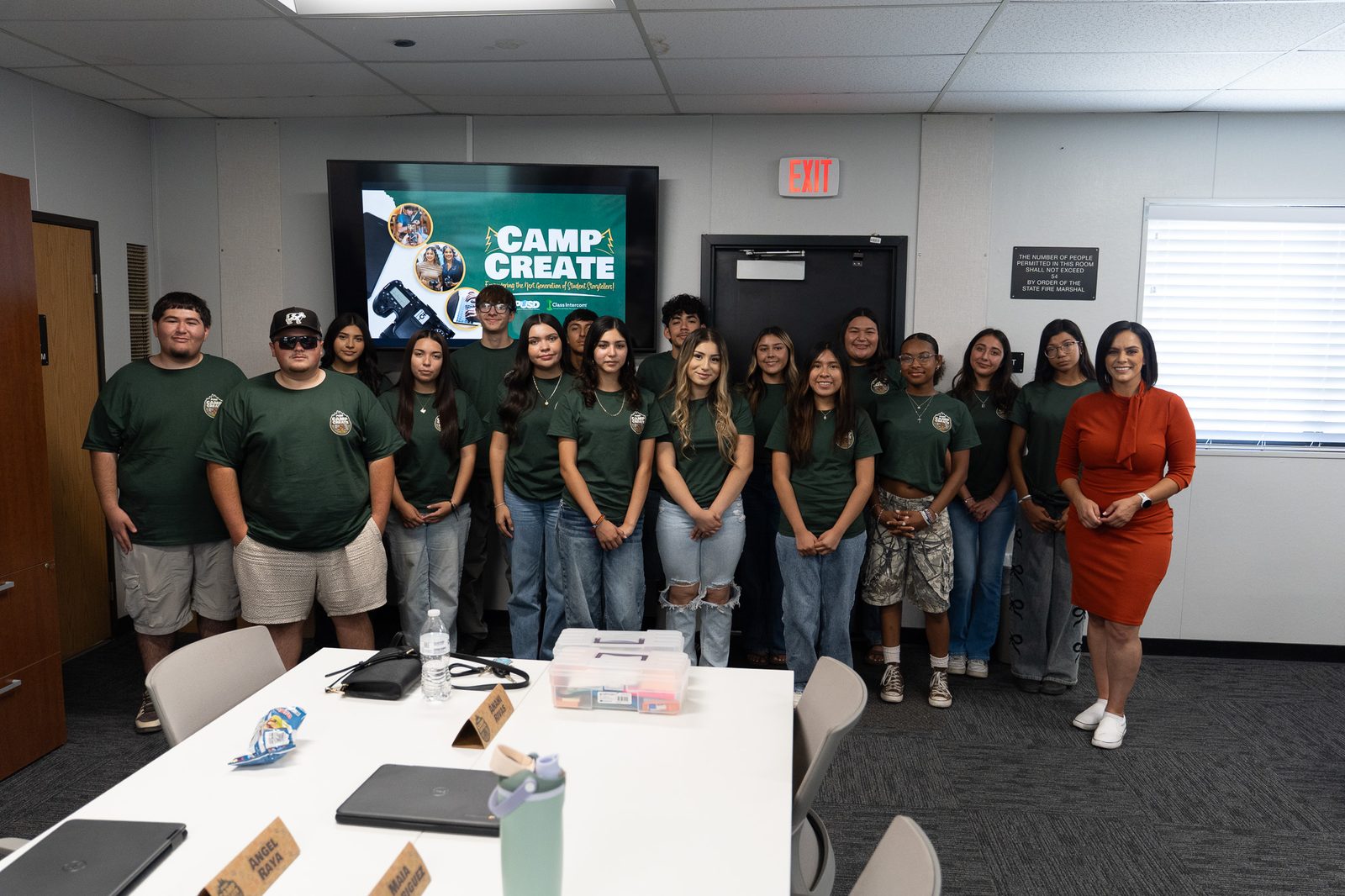
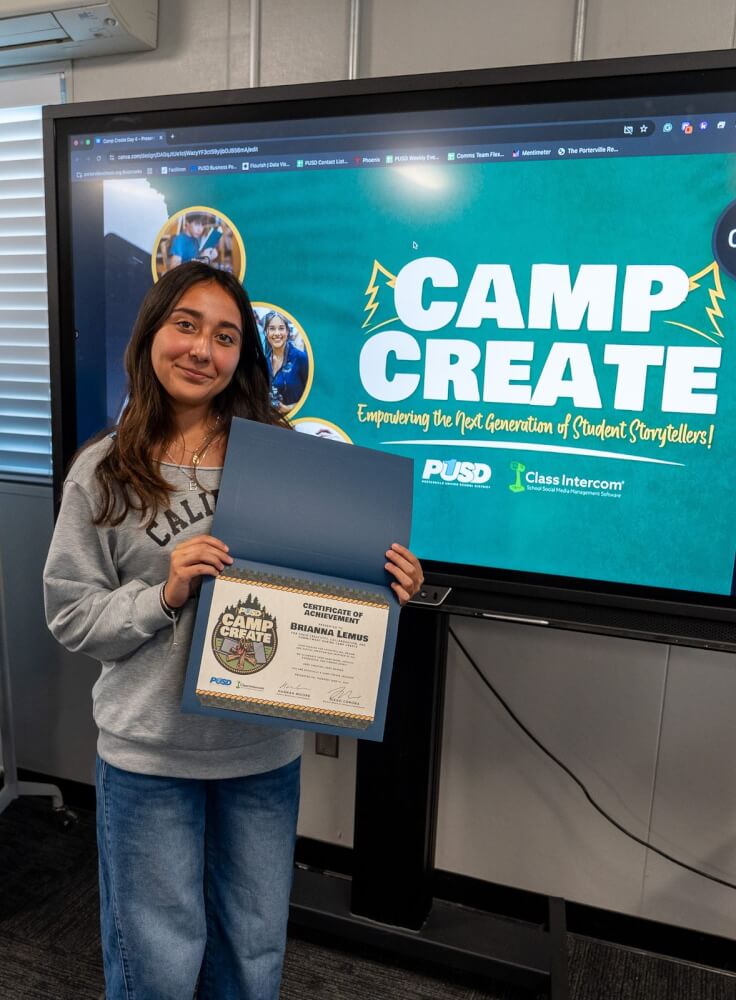
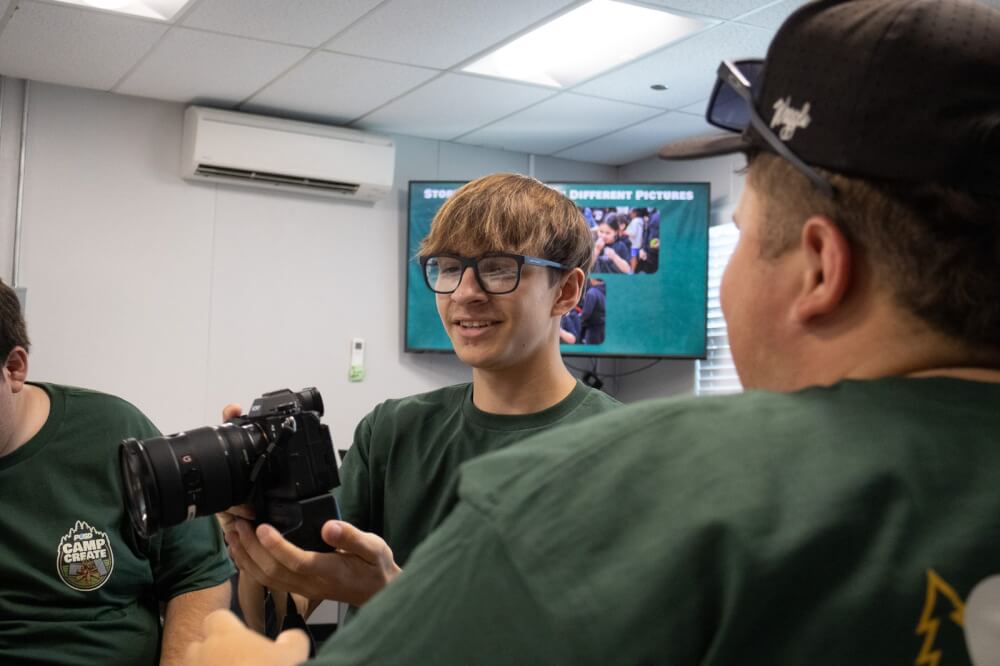
Each summer, students from across Porterville’s high schools spend a week immersed in photography, videography, graphic design, branding, interviewing, and visual storytelling. The camp, dubbed Camp Create, is run by Diego and Hannah, and the atmosphere feels less like a summer class than a creative studio. Students move between cameras and laptops, brainstorm story ideas, critique one another’s work, and hear from professionals working in media and marketing.
Through speakers, activities, and projects, students are challenged to produce creative work in different mediums, but the curriculum itself is also fluid. At the end of each day, Hannah and Diego ask students a simple question: What do you want to learn tomorrow? The answer shapes the next day’s lessons.
That flexibility reflects the way they approach the entire program. Students aren’t expected to fit into predetermined roles. They’re encouraged to discover where their interests naturally lead.
“We wanted to create a space for students that didn’t just feel like another class,” Diego says. “A place where they could start creating without the fear of failing or doing something wrong.”
Some students have gravitated toward photography. Others have discovered they enjoy interviewing classmates or editing video. One student, who spent weekends photographing customized cars, found that the same eye for composition translated naturally to documenting student life around campus. Another produced a feature highlighting Native American Heritage Month through interviews with fellow students–a story that may never have surfaced otherwise.
“We saw them fall into different roles naturally,” Hannah adds, noting the value of leaving space for students to pursue their unique skills and interests. “The student who wanted to be behind the camera got to lean into those strengths instead of, say, being pushed to be actually on camera.”
Over the course of the week, students use Class Intercom’s school social media management suite to collaborate with peers, submit content, and receive feedback from Hannah and Diego–providing a safe, professional environment for students to learn real-world skills.
Building Systems Around Student Voice
Camp Create has since grown into something larger than a week-long experience. Hannah and Diego have carried the same approach into classrooms, elementary media clubs, and other opportunities throughout the school year. Students bring what they learned back to journalism classes, creative pathways, and school projects, while many still talk about the friendships they formed with peers from campuses they otherwise may never have visited. Looking ahead, Hannah and Diego hope to build on that foundation with a paid student internship that would keep students creating, collaborating, and telling the district’s story long after summer ends.
It’s a tried-and-true solution to a challenge that’s all-too familiar to school communicators everywhere: As school PR and communications professionals, you simply can’t be everywhere at once.
Stories are happening across Porterville’s campuses, clubs, classrooms, and teams every day. Teachers end up with photos sitting on their phones. Coaches have game highlights. Club advisors have videos from competitions and performances. Gathering everything into one place–and doing it safely and compliantly–quickly becomes almost as challenging as telling the stories themselves.
“There has to be a better way for us to get pictures and information from people,” Hannah remembers thinking.
Class Intercom became the missing link.
Instead of sharing passwords or relying on emails and text messages, Class Intercom’s school social media management suite makes it easy for students, teachers, and staff to submit photos, videos, and captions to a central, moderated platform. Users with moderator- or admin-level access (like Hannah and Diego), review submissions, provide feedback when needed, and approve content before anything is published. The result is a curated approach to storytelling that allows many voices to contribute–whether students, parents, coaches, school ambassadors, teachers, or a combination. For communications professionals at the district level, the system creates a constant influx of engaging content that reflects the diverse realities of students, programs, classes, teams, and other groups across the school community. Simply put, it means students are able to engage in storytelling in a way that spotlights their peers. The result is more visibility and overall goodwill from the community, who sees and engages with these stories on social media.
For Diego, there’s also an important alignment in philosophy. Class Intercom was built on the idea that students have important insights and perspectives on their school communities and that (with the right systems and guidance) they can tell powerful and engaging stories.
“Class Intercom empowers students, and it adds a safeguard,” he says. “It’s been a really great foundation for building this program.”
“Class Intercom empowers students, and it adds a safeguard. It’s been a really great foundation for building [the Camp Create] program.”
Diego Corona, Porterville Unified School District (Porterville, CA)
In the end, Class Intercom opens the door for more people to contribute: A teacher who captures an experiment in science class. A student covering a football game. An elementary media club producing its morning announcements. Together, those moments create a richer and more complete picture of life across Porterville Unified than any two-person communications team could produce on its own.
A Community Invested in Students
Hannah and Diego are quick to point out that Camp Create has never been a two-person effort.
Throughout the program’s growth, they’ve credited district leadership for trusting new ideas and giving them room to experiment.
“We come from a district that’s often on the cutting edge,” Hannah says, adding that student impact is a foremost consideration in every decision. “The approach is very much: Is it good for the kids? Is it feasible? Let’s do it!”
That support has allowed the program to evolve organically. Some ideas have grown faster than expected. Others have changed shape entirely. Conversations are already underway about expanding opportunities through student internships and additional pathways into the communications department.
For Hannah and Diego, though, success isn’t measured by how many programs they launch.
It’s measured in quieter moments: The student who discovers a talent for photography. The friendships that form between teenagers from different high schools. The confidence that comes from seeing your work published for your community to see.
Hannah still thinks about students who chose Camp Create over a week of paid work in the fields–a decision that wasn’t easy for every family. During camp, the district even sent extra lunches home to help support younger siblings while students attended. Those moments reinforced something both she and Diego had felt from the beginning: opportunities only matter if students can realistically access them.
Showing them that their interests can be a career has been especially fulfilling for both her and Diego. “We’re not educators and don’t have education backgrounds,” adds Hannah. “But, as an adult and professional, it’s really reinforced in us that, in the school world, you can also be a mentor.”
In Porterville, the stories students tell through cameras, interviews, graphics, and social media posts have become part of the district’s public identity. Just as meaningful are the stories students begin telling themselves–about what they’re good at, where their interests might take them, and the futures they can begin to imagine.
Porterville is one of thousands of schools and districts nationwide using Class Intercom’s technology to empower students and create meaningful learning opportunities. Interested in learning more about implementing a program like Camp Create at your school? Let’s connect.